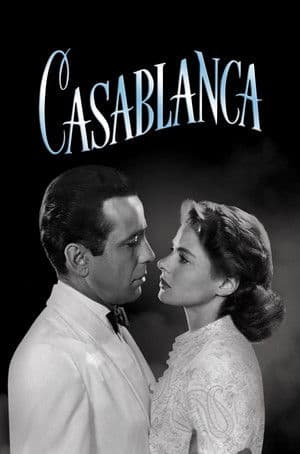
Casablanca in Wartime: The Setting and Its Inhabitants
The year is 1941, and the city of Casablanca, in the French protectorate of Morocco, has become a desperate transit point for thousands of European refugees fleeing Nazi occupation. The usual route runs from Europe to Casablanca, and from there to Lisbon, where it is possible to board a ship to America. However, obtaining the documents needed to leave Casablanca is extraordinarily difficult, and the city teems with traffickers, spies, corrupt officials, and hopeless exiles waiting for a visa that may never come. The collaborationist French Vichy administration, acting in concert with Nazi Germany, controls the city under the direct supervision of German officers.
It is in this atmosphere of tension and corruption that Rick Blaine (Humphrey Bogart) thrives — an American citizen with a mysterious past who runs the Rick's Café Américain, Casablanca's most popular establishment. The café is a meeting point for all manner of characters: gamblers, refugees, French and German officers, visa traffickers, and spies of various nations. Rick is presented from the outset as a man of deep cynicism, claiming to be committed to no cause and willing to risk nothing for anyone. "I stick my neck out for nobody," he declares in one of his first lines, establishing the mask he wears. Yet small details reveal that he was once a man of principle: he fought alongside the Republicans in the Spanish Civil War and ran guns to Ethiopia against the Italian invasion, always on the side of the oppressed.
The Inciting Event: The Arrival of Ilsa and Laszlo
On the night that sets the plot in motion, Captain Louis Renault (Claude Rains), Casablanca's prefect of police and a pragmatic man who serves whoever is in power while retaining a core of decency, warns Rick that a very special guest will be visiting the café that evening: Victor Laszlo (Paul Henreid), the celebrated Czech resistance leader, wanted by the Gestapo across Europe. Laszlo has escaped from concentration camps twice and represents a top political priority for the Nazis. Major Heinrich Strasser (Conrad Veidt), an SS officer stationed in Casablanca, has traveled there expressly to prevent Laszlo from leaving the territory.
That same night, Victor Laszlo enters Rick's Café accompanied by his wife, Ilsa Lund (Ingrid Bergman). The moment the club's pianist, Sam (Dooley Wilson), sees the woman, his face registers uneasy recognition. Ilsa asks him to play "As Time Goes By," a song Sam is reluctant to perform. When Rick comes over to reprimand him for playing that melody, he sees Ilsa for the first time in years and his composure instantly shatters.
Through a series of flashbacks set in Paris, the viewer discovers the history between Rick and Ilsa. In the spring of 1940, the two shared a passionate romance in the city before the Germans seized it. They planned to flee together by train, but at the last moment Ilsa did not appear at the station, leaving only a note telling him she could not go with him and asking him never to look for her again. Rick departed alone, heartbroken, unable to understand why she had left. It is this unresolved pain that has shaped the cynicism and emotional guardedness he displays in Casablanca.
The central conflict is thus laid out with precision: Rick possesses two stolen letters of transit — documents that allow unrestricted travel to any destination — which could get Laszlo out of Casablanca. Laszlo urgently needs them to continue his work in the resistance. But Ilsa's presence complicates everything: Rick must decide whether to help the cause he would once have given his life for, whether to take revenge for the abandonment he suffered by withholding the papers, or whether to listen to what Ilsa has to tell him about what really happened in Paris. The love triangle and the moral dilemma are established from the very first act of the story.