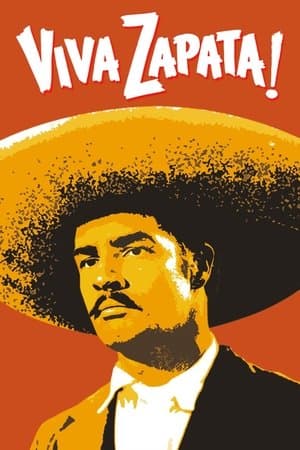
Viva Zapata!
Director: Elia Kazan
Cast: Marlon Brando, Jean Peters, Anthony Quinn, Joseph Wiseman, Arnold Moss
Biography of Emiliano Zapata (1879–1919), the famous Mexican revolutionary who rallied the entire country against the dictatorial government of President Porfirio Díaz. Kazan attempts to show how revolutionary leaders become corrupted once they attain power. The screenplay was written by none other than John Steinbeck, author of _The Grapes of Wrath_ and _East of Eden_.
⚠ Contains spoilersMexico under the Díaz Regime
The story unfolds in Mexico during the early years of the twentieth century, in the final period of the dictatorship of Porfirio Díaz, who has governed the country with an iron fist for decades. The peasants of the state of Morelos live under profound injustice: their ancestral lands have been seized by wealthy landowners, with the complicity or outright indifference of the government. The indigenous and mestizo communities of the country's south survive in conditions of poverty, with no access to justice or to any legal mechanism capable of protecting their most basic rights.
Against this backdrop, the film opens with a scene that immediately establishes the tone of the conflict. A group of peasants from the Morelos region appears before Díaz himself to lodge a complaint about the lands that have been taken from them. Among them is Emiliano Zapata, a young indigenous man of fiery temperament and intense gaze, who stands out from the rest by his willingness to confront the dictator with an attitude that mingles respect and defiance. When Díaz asks his name and points to it on a map with a condescending gesture, Zapata does not flinch and traces his finger around the name of his own village, as if demanding visibility for his people. Díaz reads this gesture as a sign of danger and orders the man to be watched, recognizing in him a spark that could become a conflagration.
The Characters and Their Motivations
Emiliano Zapata does not begin the film as a fully formed revolutionary, but as a man of the people with an innate sense of justice. His initial motivation is concrete and personal: to defend the lands of his community and his neighbors against the abuses of the landowners. He does not yet possess an elaborate political ideology, but rather a deep moral conviction that what is happening is unjust and that someone must do something about it. His natural courage and his ability to articulate collective grievances quickly make him a de facto leader among the peasants of Morelos.
Fernando Aguirre is a character of a more ambiguous and intellectual nature. He presents himself as an educated man with political and revolutionary awareness, who approaches Zapata having recognized in him the potential to lead an armed movement. Fernando acts as ideological mentor and strategist, but from the outset displays a calculating coldness that contrasts with Zapata's human warmth. His true motivations remain partially veiled: he claims to be fighting for the people, but his relationship with power reveals an ambition and a more Machiavellian vision of revolution.
Josefa Espejo is the middle-class young woman whom Zapata courts. She comes from a family of higher social standing than his, which turns their relationship into another front of tension. Josefa represents the world of stability and bourgeois respectability, yet she also feels genuine attraction toward Zapata. Her father initially opposes the relationship, considering it socially inappropriate.
Eufemio Zapata, Emiliano's older brother, appears as a fellow fighter from the beginning. He shares his brother's cause, but his character is rougher, less reflective, and more given to excess, which foreshadows from early on the tensions that will arise between the two in later stages of the story.
The Inciting Incident: From Peaceful Complaint to Armed Resistance
The true inciting incident occurs when the authorities and the landowners, far from addressing the peasants' grievances, respond with greater repression. Peasants who attempt to reclaim or simply work their own lands are harassed, imprisoned, or brutalized by the rurales, the rural police in the service of the regime. Zapata witnesses firsthand how the legal and peaceful approach he himself attempted before Díaz is utterly useless, for the system is designed to protect the powerful.
The situation escalates when Zapata is pursued and forced to flee, marking him as a dangerous agitator. This moment of definitive rupture with any hope of an institutional solution is what drives him onto the path of armed rebellion. News of Francisco I. Madero and his call to revolution against Díaz provides the political framework within which Zapata and his men can situate their local struggle within a broader national movement.
The film's central conflict is thus established: the fight of the peasants of southern Mexico to recover their lands, embodied in the figure of Zapata, who must navigate between his deepest convictions, the demands of war, complex political alliances, and his own transformation from a man of the people into a revolutionary symbol.