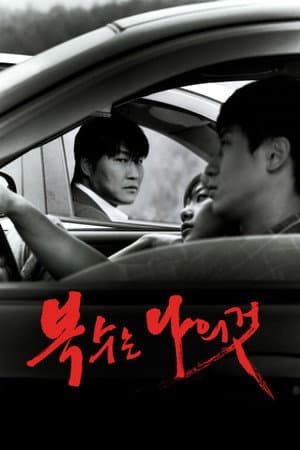
Sympathy for Mr. Vengeance
복수는 나의 것
Director: Park Chan-wook
Cast: Song Kang-ho, 신하균, Bae Doona, 임지은, 한보배
A deaf man and his girlfriend resort to desperate measures to fund a kidney transplant for his sister. Things go terribly wrong and the situation quickly spirals into a cycle of violence and revenge.
⚠ Contains spoilersRyu's World and the Desperate Problem
Ryu is a young deaf-mute man who works in a metal factory in South Korea. He lives in a modest apartment with his sister, Yeong-mi, who suffers from severe kidney failure and urgently needs a kidney transplant to survive. Ryu is his sister's sole support and has spent months trying to raise the money needed to pay for the operation. Ryu communicates with the outside world through sign language and written notes, making him an isolated figure confined to a bubble of silence that director Park Chan-wook underscores visually from the film's opening minutes. His girlfriend, Cha Young-mi, is a young radical left-wing activist who shares the apartment with him and who, in contrast to her idealistic and political nature, takes a more pragmatic stance when it comes to helping Ryu in his desperation.
Yeong-mi's condition deteriorates progressively. Ryu is registered as a potential kidney donor, but his blood type is incompatible with his sister's, making a direct donation impossible. Despite being on a waiting list for a compatible organ, time is running out. Against this backdrop of urgency and financial exhaustion, Ryu is laid off from his job at the factory — the definitive trigger that pushes him toward desperate and morally compromised decisions.
The Deal with the Traffickers and the First Fatal Mistake
Without work and without legal options, Ryu makes contact with a clandestine organ trafficking network. The deal is as follows: Ryu will surrender his own healthy kidney — the only one he can offer — in exchange for cash and a compatible organ for his sister. After the illegal operation, Ryu wakes up in an abandoned warehouse, with a scar on his side and without the promised money. The traffickers have disappeared, taking his kidney but failing to uphold their end of the agreement. Ryu is left mutilated, without money, without an organ for Yeong-mi, and without a job.
It is then that Cha Young-mi proposes a plan she presents as temporary and reversible: kidnapping the daughter of a wealthy businessman to demand a ransom. The money obtained would be used to fund Yeong-mi's transplant through legal or alternative medical channels. Ryu, on the edge of despair, agrees.
Park Dong-jin and the Central Conflict
The target of the kidnapping is Yu-sun, a young girl and the daughter of Park Dong-jin, an upper-middle-class businessman who runs a company and who, paradoxically, is the same man who signed Ryu's dismissal notice. This coincidence is unknown to either party at the outset and functions as a structural irony that the film will develop later on. Park Dong-jin is introduced as a functional man with an ordered though emotionally distant life, who is going through his own marital separation. His relationship with his daughter Yu-sun is one of the few genuine emotional bonds he has left.
The kidnapping is carried out without initial violence. Ryu and Cha Young-mi take Yu-sun with the intention of keeping her in decent conditions for the duration of the negotiation. The girl apparently knows Ryu by sight, which helps ensure she does not feel immediate terror. Ryu is affectionate toward her, and there is an almost fraternal bond between them that contrasts in a disturbing way with the nature of the crime they are committing.
The central conflict is thus established from two simultaneous angles: on one hand, Ryu attempts to save his sister through a criminal act he does not perceive as monstrous but as a necessary sacrifice; on the other, Park Dong-jin, upon discovering that his daughter has disappeared, begins his own efforts to recover her, initially refusing to involve the police. The film establishes from the outset that none of its protagonists is a villain in the conventional sense, but rather that all are victims of circumstances dragging them toward violence in an almost mechanical way. The original Korean title — Boksuneun naui geot, meaning "Vengeance Is Mine" — already points to the chain of reprisals the film will unfold, one in which the concept of guilt proves impossible to assign unilaterally.