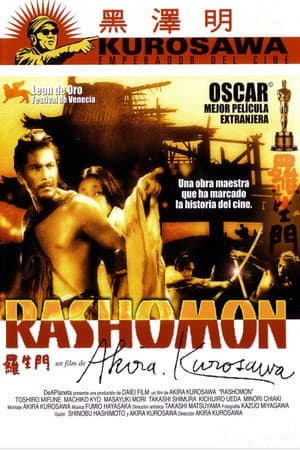
Rashomon
羅生門
Director: Akira Kurosawa
Cast: Toshirō Mifune, 京マチ子, 志村喬, 森雅之, 千秋実
Japan, 12th century. In Kyoto, beneath the gates of the crumbling Rashomon temple, a woodcutter, a Buddhist priest, and a pilgrim take shelter from a torrential downpour. The three discuss the trial of a bandit accused of murdering a feudal lord and raping his wife. The details of the crime are narrated from the perspectives of the bandit, the woman, the feudal lord—with the aid of a medium—and the woodcutter, the sole witness to the events.
⚠ Contains spoilersThe shelter from the rain and the narrative frame
The story takes place in feudal Japan, during a period of wars, epidemics, and famines that have left the country in a state of profound desolation. Against this backdrop of moral and material decay, three men find themselves stranded beneath the Rashomon Gate, an imposing ruined structure on the outskirts of the ancient capital, as a fierce storm batters the city. The three men are the woodcutter, an anonymous peasant who has witnessed something disturbing in the forest; the Buddhist priest, a man of deep faith profoundly shaken by what he has seen and heard; and the rogue, or peddler, a stranger seeking shelter who serves as a skeptical interlocutor, pressing the other two to recount what happened.
The woodcutter and the priest attended that same day a trial held before the local magistrate, in which an attempt was made to shed light on the death of a samurai. Both are visibly troubled—not so much by the crime itself as by the impossibility of determining what actually occurred. The rogue, curious and pragmatic, urges them to tell what they know. It is through this conversation beneath the rain that the film organizes its structure: the contradictory testimonies heard during the trial are presented one by one, building a fragmented account of a single event.
The crime in the forest and the contradictory testimonies
The central incident is the death of the samurai Takehiro and the sexual assault suffered by his wife, Masago, which took place in a nearby forest. The alleged perpetrator is Tajomaru, a bandit notorious and feared throughout the region, who was captured shortly after the events and brought to justice. Yet what should be a relatively straightforward judicial proceeding becomes a labyrinth of mutually incompatible accounts.
The first testimony is Tajomaru's own. The bandit pleads guilty to the murder, but recounts the events in a way that portrays him as a man of honor in his own fashion. According to his version, he saw Takehiro and Masago passing through the forest, felt irresistibly drawn to the woman, and devised a plan to separate them. He deceived the samurai on the pretext of showing him some ancient swords buried in the forest, overpowered him, and tied him to a tree. He then returned to Masago and raped her. Up to this point the testimonies agree in their essentials, but from here the accounts diverge radically. Tajomaru claims that after the act, Masago begged him to kill her husband, since she could not live knowing that two men were aware of her dishonor. Faced with this request, the bandit says he freed Takehiro and fought him in an honest and prolonged duel, emerging victorious after a contest in which the samurai proved himself a brave adversary. In this version, Tajomaru is the killer, but acts according to a certain warrior code.
The second version comes through a medium who channels the voice of the spirit of Takehiro, the dead samurai. In this account, Masago appears as the true villain: after being raped by Tajomaru, the woman actively incites the bandit to kill her husband, displaying a coldness and cruelty that utterly contradict the image of a passive victim. According to Takehiro's spirit, Tajomaru, repulsed by Masago's request, rejected her and fled. It was then that the woman, feeling abandoned and dishonored, also fled. Takehiro, consumed by despair and shame, picked up Masago's dagger, which had fallen to the ground, and plunged it into himself. This version turns the death into a suicide.
The third version is Masago's own. She appears before the magistrate weeping and visibly distressed. According to her, after the rape Tajomaru left. Masago, broken by grief, sought comfort from her husband, but found in Takehiro's eyes a gaze of cold, unbearable contempt. Unable to bear that rejection, she lost consciousness, and upon waking found her husband dead with the dagger plunged into him. She does not clearly remember what happened, suggesting that she herself may have killed him without being aware of it, though her account is deliberately ambiguous.
The woodcutter, as he listens to the priest's account and recalls the trial, remains silent about a crucial detail: he himself was in the forest and found the bodies before anyone else. What he saw there contradicts the three previous versions in fundamental respects, and that initial silence defines the central conflict of the story: the impossibility of knowing the truth, and the ease with which human beings distort it in accordance with their own interests, fears, and desire to protect their image.