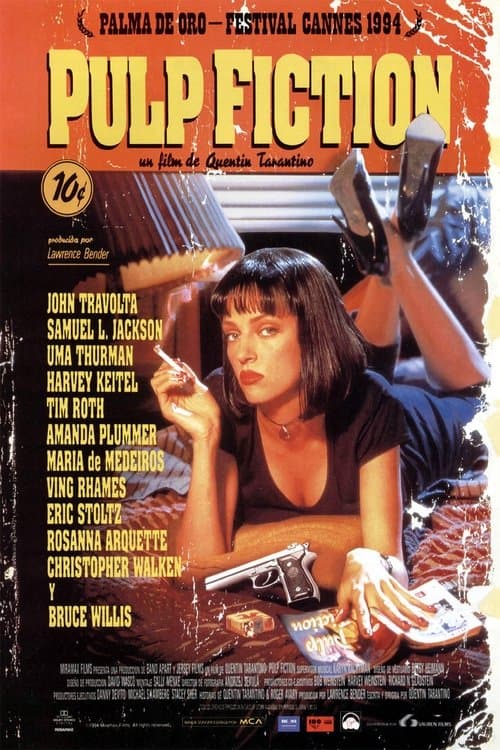
Pulp Fiction
Director: Quentin Tarantino
Cast: John Travolta, Samuel L. Jackson, Uma Thurman, Bruce Willis, Ving Rhames
Jules and Vincent, two dim-witted hitmen, work for Marsellus Wallace. Vincent confides in Jules that Marsellus has asked him to look after Mia, his wife. Jules advises caution, warning that getting too close to the boss's girlfriend is a dangerous proposition. When it's time to get to work, both men must get down to business. Their mission: retrieve a mysterious briefcase.
⚠ Contains spoilersA Fragmented Criminal Universe
Pulp Fiction (1994), directed by Quentin Tarantino, tells its story through a non-linear structure divided into interconnected chapters that chronologically reorder events to alter the viewer's perception. The story unfolds in Los Angeles over the course of several days and revolves around a cast of characters from the criminal underworld whose lives intersect in unexpected and, at times, fatal ways.
The film opens with a scene in a diner where Pumpkin, also known as Ringo, and his girlfriend Yolanda — alias Honey Bunny — discuss their criminal strategy. They are small-time robbers who have developed a method of holding up restaurants instead of banks or liquor stores, considering them safer targets. In a rash and excitable impulse, they decide to rob the very establishment they are sitting in right then and there, drawing their weapons on the other patrons. This sequence serves as a narrative prologue and reappears at the end of the film with an outcome that is not shown the first time around, closing the film's structural circle.
The Hitmen and Marsellus Wallace's Briefcase
The central narrative block that functions as the primary introduction to the criminal universe follows Vincent Vega and Jules Winnfield, two hitmen who work for Marsellus Wallace, a powerful and feared Los Angeles gangster. The two men are introduced in suits, driving through the city while engaged in an apparently trivial conversation about cultural differences between Europe and the United States, specifically about hamburgers and the eating of pork. This mundane, almost philosophical exchange immediately establishes the film's stylistic register: violent characters capable of reflecting on everyday matters with a naturalness that stands in stark contrast to the brutality of their actions.
Vincent and Jules head to the apartment of several young men who worked for Marsellus and have made the mistake of stealing a mysterious briefcase from him. The contents of the briefcase are never explicitly revealed — only a golden light is seen emanating from it when it is opened — but its value to Marsellus is absolute and justifies any measure. The young men are executed by Jules and Vincent following a biblical monologue that Jules recites before shooting, the passage of Ezekiel 25:17, which the character himself reinterprets at the end of the film as a reflection on his own moral identity. One of the young men, hidden in the bathroom, emerges firing without hitting either hitman. Jules interprets this as a divine miracle, triggering a profound existential crisis in him that will lead him to consider abandoning his criminal life.
Vincent, by contrast, is a more pragmatic and hedonistic man, recently returned from a stint in Europe. He is addicted to heroin and maintains a detached attitude toward grand moral dilemmas. His primary motivation in this first section is to carry out Marsellus's request: to take Mia Wallace, his boss's wife, out to dinner while Marsellus is out of town. The request carries an implicit tension: Vincent is well aware that Marsellus physically harmed a man who merely gave Mia a foot massage, which makes the evening an assignment as routine as it is potentially lethal should any lapse in judgment occur.
Marsellus Wallace and the Power Structure
Marsellus Wallace requires little direct introduction to exert a constant pressure on the narrative. He is the gravitational center around which all other characters orbit. His power is absolute within the criminal underworld the story inhabits, and his presence inspires fear even in those who serve him loyally. In addition to being Vincent and Jules's employer, Marsellus is connected to another storyline: he has paid a boxer, Butch Coolidge, to take a dive in an upcoming fight. Butch accepts the money but, for reasons the film will gradually reveal, has no intention of honoring the agreement. This decision marks Butch as a man on borrowed time — someone who has betrayed the most dangerous person in his world and will have to run to survive.
The central conflict of Pulp Fiction does not follow a single dramatic thread but rather a web of simultaneous tensions: Vincent's evening with Mia and its implications, Butch's flight following his betrayal of Marsellus, and Jules's moral transformation in the wake of the apartment incident. All of these threads, though seemingly independent, share the same ecosystem of violence, loyalty, money, and irreversible decisions.