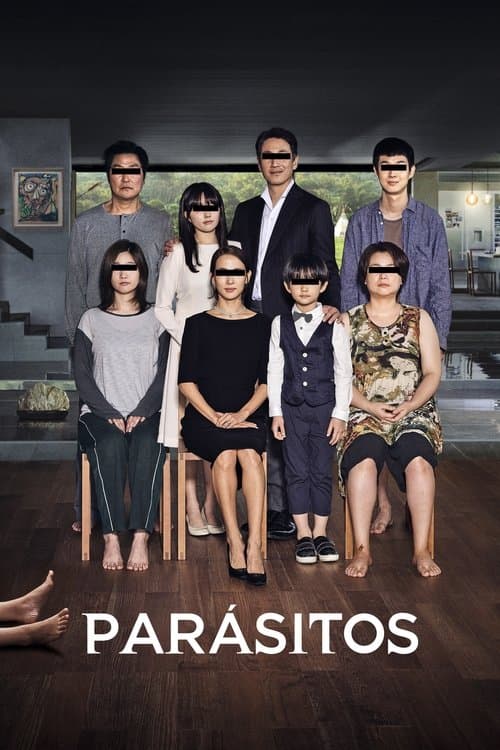
Parasite
기생충
Director: Bong Joon-ho
Cast: Song Kang-ho, Lee Sun-kyun, Cho Yeo-jeong, Choi Woo-shik, Park So-dam
Ki-taek (Song Kang-ho) and his entire family are unemployed. When his eldest son, Ki-woo (Choi Woo-sik), begins tutoring Da-hye, the teenage daughter of the wealthy Park family (Lee Sun-kyun), the two households—which have more in common than their vastly different worlds might suggest—become entangled in a relationship with unpredictable consequences.
⚠ Contains spoilersThe Ki-taek family and life in the semi-basement
The story begins in Seoul, South Korea, where the Ki-taek family (played by Song Kang-ho) scrapes by in a tiny semi-basement apartment known in Korean as a banjiha. The home, damp and barely lit, sits below street level, its windows looking directly onto the pavement and the feet of passersby. The family has four members: Ki-taek, the unemployed father with no clear prospects; Chung-sook (Jo Yeo-jeong), his equally jobless wife; the eldest son, Ki-woo (Choi Woo-shik), an intelligent young man who has failed the university entrance exam several times; and the daughter, Ki-jung (Park So-dam), talented and sharp, with self-taught skills in graphic design and document forgery.
The family survives through precarious odd jobs, such as folding pizza boxes for a delivery company, and by piggybacking on the Wi-Fi signals of nearby businesses to get online. Their economic hardship is total and structural: this is not a temporary crisis but a chronic condition in which none of the four family members has managed to secure stable formal employment. Despite this, their family life is close and warm, defined by collective resourcefulness and a complicity that will become the foundation of their future schemes.
The catalyst: the opportunity at the Park household
The precarious equilibrium is shattered when a friend of Ki-woo's named Min-hyuk visits the semi-basement before leaving the country to study abroad. Min-hyuk proposes that Ki-woo replace him as the English tutor for Da-hye (Jung Ziso), the teenage daughter of the wealthy Park family. Since Ki-woo does not have the academic credentials required for the position, Ki-jung skillfully forges a university certificate accrediting him as a student at a prestigious institution. Document in hand, Ki-woo presents himself at the Parks' luxurious mansion, designed by the acclaimed architect Namgoong Hyeonja and located in an upscale residential area of Seoul.
The Park family is headed by Park Dong-ik (Lee Sun-kyun), a successful business executive who is cold and distant with his employees, though superficially polite and condescending. His wife, Yeon-kyo (Cho Yeo-jeong), is a naïve, credulous, and easily manipulated woman, entirely removed from the economic realities faced by most of the population. Her daughter Da-hye becomes Ki-woo's student, and he also begins to develop a romantic attraction toward her. The Parks' young son, Da-song (Jung Hyeon-jun), is an eccentric child with a fondness for primitive art who, years earlier, witnessed something traumatic in the house's basement — an event that appears to have left him with lasting psychological scars.
The gradual infiltration and the central conflict
Once inside the mansion, Ki-woo sets a systematic family infiltration plan in motion. He convinces Yeon-kyo to hire Ki-jung as an art therapist for Da-song, presenting her under the false name "Jessica" and with equally fabricated credentials. Ki-jung, delivering a flawless performance, quickly earns Mrs. Park's trust. The family then schemes to place Ki-taek as Dong-ik's driver, which requires getting rid of the previous chauffeur, Yoon (Park Keun-rok). Ki-jung plants false evidence in Mr. Park's car to suggest that Yoon had engaged in sexual activity inside the vehicle, resulting in his immediate dismissal. Ki-taek takes his place.
Finally, the plan is completed with Chung-sook's installation as the new housekeeper, after the family maneuvers to have Moon-gwang (Lee Jung-eun) — the domestic employee who has worked in the house for years — dismissed through a false accusation of tuberculosis. With all four members of the Ki-taek family embedded in the Parks' household staff under fictitious identities and relationships — their employers entirely unaware that they are related — the plan appears to have worked perfectly.
The film's central conflict is thus framed as a class tension sustained by a collective lie: a family without resources that has parasitized the comfort ecosystem of a wealthy family, occupying their spaces, consuming their resources, and reshaping their daily life. Yet the situation carries within it the seeds of its own destruction, as the truth about the hidden identities, the house, and its darkest secrets threatens to surface at any moment.