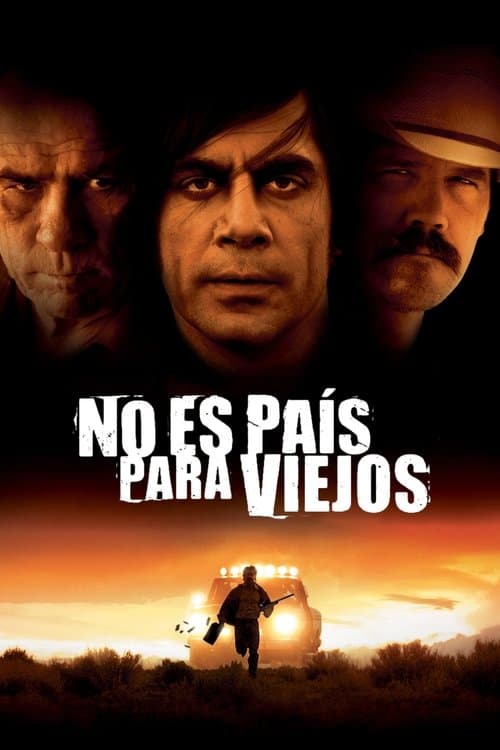
The World in 1980: Border Texas and Everyday Violence
The story unfolds in 1980 in the desert region of west Texas, near the border with Mexico. Terrell County and its surroundings form a barren, sparsely populated landscape where law enforcement operates with difficulty and where organized crime tied to drug trafficking has begun to permeate an area historically defined by self-reliance and the code of values of the old American West.
Ed Tom Bell is the county sheriff, a middle-aged man whose family has held that office for generations. Bell embodies an almost anachronistic conception of justice: he believes in the moral order, in the possibility of protecting the innocent, and in a comprehensible relationship between crime and punishment. Yet from the very beginning of the film, his voice-over anticipates a feeling of defeat and estrangement in the face of a world he no longer recognizes. Bell senses that the violence he now confronts follows no human logic he is capable of deciphering, and that incapacity defines him as a character throughout the entire narrative.
The Inciting Incident: Llewelyn Moss and the Money in the Desert
The central conflict is set in motion when Llewelyn Moss, a Vietnam veteran who works as a welder and lives in a trailer with his young wife Carla Jean, heads out into the desert to hunt pronghorn. During his outing, Moss discovers the aftermath of a drug trafficking operation that has ended in a massacre: several vehicles, the corpses of armed men, and dead dogs surround the scene of a gunfight. Following a trail of blood, Moss locates a dying man who asks him for water and, further on, finds the body of the last survivor alongside a briefcase containing approximately two million dollars in cash.
Moss takes the money and brings it back to his trailer. That night, however, he returns to the scene of the crime to bring water to the dying man — a decision driven not by any survival logic but by a moral impulse that ultimately proves fatal for him. Upon returning, he finds the site is being watched and must flee on foot through the desert while being pursued by armed men in trucks. He manages to escape, but his presence at the scene has been registered. From that moment on, Moss becomes the target of multiple parties seeking to recover the money.
Anton Chigurh: Violence as an Absolute Principle
The most consequential character in the story is Anton Chigurh, a hired assassin contracted to recover the money on behalf of those who financed the drug trafficking operation. Chigurh operates under no conventional criminal code: he does not kill for money, he does not kill for survival, and he does not negotiate in practical terms. His value system is a philosophy of fate and inevitability. He regards certain deaths as simply the logical outcome of prior decisions, and considers any interference with that process to be dishonest. To decide whether to kill someone who is not directly on his list of targets, he sometimes flips a coin, leaving the outcome to chance.
His signature weapon is a captive bolt pistol — the same tool used in slaughterhouses to kill livestock — with which he blows out door locks and kills his victims. Within the film's first few minutes, Chigurh kills a police officer who has pulled him over by strangling him with his own handcuffs, and shortly thereafter executes a civilian motorist for no apparent reason beyond the logic of leaving no witnesses. His presence introduces into the narrative a form of violence that Bell can neither anticipate nor contain.
The Pursuit Triangle and the Central Conflict
The narrative structure is established through three converging storylines. Moss flees with the money, moving from motel to motel across Texas and eventually toward the border, trying to keep Carla Jean safe by sending her to her mother's house. Chigurh tracks him using an electronic transponder hidden inside the briefcase, eliminating anyone who gets in his way. Bell investigates the crimes from behind, always arriving late to scenes of violence, unable to reach either of the two men he is looking for.
The central conflict is not solely a chase for money. From its initial setup, the film poses a question about the nature of evil and about the capacity of institutions — represented by Bell — to confront it. Bell is not only pursuing Chigurh: he is trying to understand what kind of world produces someone like him, and that question finds no satisfactory answer. The money is the trigger, but what the story puts at stake from the outset is the possibility that there exists a form of violence that escapes entirely any moral or institutional framework capable of containing it.