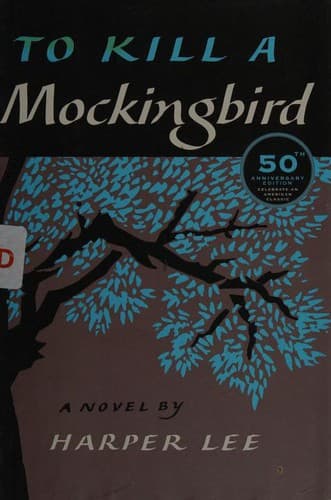
To Kill a Mockingbird
Author: Harper Lee
In a small town in the American South during the Great Depression, young Scout Finch watches as her father Atticus, a lawyer, defends Tom Robinson, a Black man unjustly accused of raping a white woman.
⚠ Contains spoilersThe World of Maycomb and the Finch Family
The story takes place in Maycomb, a small fictional town in the state of Alabama (in the American South), during the years of the Great Depression, approximately between 1933 and 1935. The narrator is Scout Finch (whose full name is Jean Louise Finch), a six-year-old girl at the start of the story who looks back from adulthood on the events of her childhood. This narrative voice establishes from the outset a dual perspective: the innocence of the girl who lived through the events and the more mature understanding of the woman who reconstructs them.
Scout lives with her father, Atticus Finch, a thoughtful, widowed, middle-aged lawyer, and her older brother Jem Finch, age ten. The family home is looked after by Calpurnia, a Black woman who serves as cook and domestic authority figure, and who represents one of the few everyday links between the Finch family and Maycomb's African American community. Atticus is a reflective, principled man deeply committed to justice and equality—values he tries to pass on to his children through conversation and example. He holds a respected position in Maycomb, though his moral outlook frequently sets him apart from the community's dominant social conventions.
Maycomb is a town defined by its slowness, its heat, and the rigidity of its social hierarchies. Racial segregation is a structural and unquestioned reality for most of its inhabitants. The white community and the Black community coexist within a framework of legal and cultural separation that is simply taken for granted. This atmosphere forms the backdrop against which all of the book's conflicts unfold.
The Neighborhood Characters and the Incident That Transforms the Story
During the first summers of the narrative, Scout and Jem befriend Dill Harris, an imaginative boy who spends his vacations at his aunt's house, next door to the Finches. The three children share games, adventures, and a growing fascination with Boo Radley (Arthur Radley), the mysterious occupant of a nearby house who never ventures outside. Local legend describes him as a disturbed and dangerous figure. The children invent games around him and attempt, without success, to draw him out. Throughout the story, Boo Radley leaves small gifts hidden in the hollow of a tree for Scout and Jem, though it takes them some time to grasp their significance. This silent character is one of the book's central thematic pillars: the gap between the image society projects onto an individual and that person's true nature.
The spark that ignites the central conflict comes when Atticus is appointed by the court to defend Tom Robinson, a Black man accused of raping Mayella Ewell, a young white woman from a poor, marginalized Maycomb family. Mayella's father, Bob Ewell, is a violent, alcoholic, and deeply racist man who embodies the most degraded stratum of the white Southern society. The accusation against Tom Robinson does not stem from a rigorous investigation but from a social dynamic that makes the conviction of a Black man accused by a white woman almost automatic, regardless of the evidence.
Atticus agrees to defend Tom Robinson not out of circumstance but out of personal conviction. He knows Tom is innocent and that defending him means confronting the racial prejudice of the entire community. This decision turns the Finches into targets of hostility from a significant portion of Maycomb. The children begin hearing insults directed at their father, and Scout must learn to suppress her instinct to respond with violence, following Atticus's instructions.
Tom Robinson is sketched from the outset as a hardworking, humble man with a physical limitation: his left arm is rendered useless by a previous accident. This physical detail will prove decisive during the trial, since Mayella's injuries are on the side opposite to where Tom could have struck her. In the context of Maycomb, however, the logic of the facts competes at a disadvantage against the weight of racial prejudice.
The book's setup thus establishes two parallel and interconnected conflicts: the legal proceedings against Tom Robinson, which force the characters and the reader to confront the institutionalized racial injustice of the American South, and the moral education of Scout and Jem, who through their father's eyes begin to understand that the world contains a systematic cruelty that cannot always be defeated, but that must always be named.