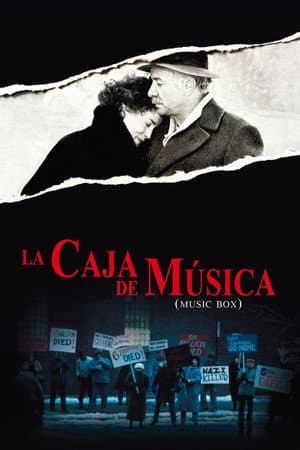
Music Box
Mike Laszlo, a Hungarian immigrant who has been living peacefully in the United States for more than 40 years, becomes embroiled in proceedings in which he is accused of having been a Nazi war criminal during World War II. Mike's daughter Ann, a successful attorney, takes on the task of defending her father with everything she has. Mike insists he is the victim of a Communist plot, but as the proceedings advance, doubts begin to assail Ann.
⚠ Contains spoilersA successful attorney and her family
Ann Talbot is a criminal defense attorney in Chicago with a solid career and an impeccable reputation at the firm where she works. Divorced and the mother of a teenage son named Mikey, Ann leads an orderly, professionally ambitious life. Her relationship with her father, Mike Laszlo, is warm and close. Mike is a Hungarian immigrant who came to the United States decades ago, built a respectable life, works as a mechanic, and is well liked by those around him. To Ann, her father represents the figure of the honest man who sacrificed everything to give his family a better life in America. This idealized image of Mike is the emotional pillar on which Ann's sense of identity rests.
The family gathers to celebrate Mike's imminent acquisition of American citizenship, a formality that symbolically crowns decades of integrated life in the country. The atmosphere is one of restrained joy and family pride. However, at that very celebration, Jack Burke, an agent from the Department of Justice, appears and disrupts the festive mood with devastating news: Mike Laszlo has been identified as a suspected war criminal. According to the charges, during World War II Mike allegedly participated actively in the persecution and murder of Jews in Hungary under orders from the Nazi-collaborationist regime. The government intends to revoke his citizenship and deport him.
The central conflict: defend the father or face the truth
The accusation sets off the film's central conflict. Mike Laszlo categorically denies the charges and claims he is the victim of a case of mistaken identity or a political conspiracy. Ann, who at no point entertains the possibility that her father could be guilty, decides to take on his legal defense herself. This decision is not merely professional but deeply personal: defending her father is equivalent to defending the story of her own family, her origins, and her conception of right and wrong.
The prosecutor handling the case is Georgine Marton, a Hungarian émigré, though the most relevant prosecutorial figure in the procedural development is represented through Holocaust survivor witnesses who claim to have seen Mike Laszlo take part in atrocities. Among the key witnesses is Istvan Boday, an elderly man who says he recognizes Mike as the man who was present during deportations and executions. Ann works to discredit each testimony, arguing that the memories of people traumatized decades earlier are unreliable and that time can distort recollection.
In parallel, Harry Talbot, Ann's ex-husband and Mikey's father, observes the proceedings with growing skepticism toward the family's version of events. Also present is Georgine Marton, a Hungarian-born investigator working for the Department of Justice who possesses documentation that, according to her, directly links Mike Laszlo to specific crimes. Marton represents the opposite pole from Ann: while the attorney acts from filial loyalty, Marton acts from historical memory and a duty toward the victims.
The film's title refers to a music box that belonged to Mike Laszlo and that carries a significance which initially seems decorative or sentimental. This box, inherited from his past in Hungary, becomes a symbolically and narratively significant object as the story progresses. Its contents, which Ann discovers in the final stages of the narrative, prove to be the most compelling and devastating piece of evidence in the entire plot.
From the outset, the film poses a moral question that runs through the entire narrative: can anyone truly know the people closest to them? Ann builds her legal strategy on the certainty that her father is innocent—a certainty that does not stem from evidence but from love and from the image she holds of him. This emotional blindness, set against the accumulating testimonies and historical evidence, is the dramatic engine that drives the story from its opening minutes. The viewer, alongside Ann, witnesses a process in which each new piece of information forces a reexamination of the nature of truth when it collides with one's most intimate bonds.
The historical context is equally relevant: the film is set against the backdrop of trials against Nazi war criminals and collaborators that took place in the United States during the 1980s, when the government intensified efforts to locate and identify individuals who had concealed their pasts under new identities on the American continent.