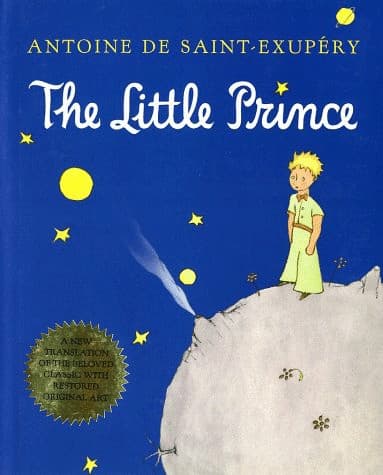
The Little Prince
Le Petit Prince
Author: Antoine de Saint-Exupéry
An aviator who has made an emergency landing in the Sahara Desert meets a boy who has come from a small asteroid. Through their conversations, the little prince recounts his travels across the universe and the strange people he has encountered.
⚠ Contains spoilersThe Narrator and His Encounter in the Desert
The story begins with the voice of an adult narrator who looks back on his childhood and his frustrating relationship with the world of grown-ups. As a boy, the Narrator drew a boa constrictor that had swallowed an elephant, but every adult around him interpreted the drawing as a hat. Faced with this universal incomprehension, the Narrator abandoned his artistic vocation and became an aviation pilot, resigning himself to dealing with people who understand only numbers and concrete data. This prologue establishes the work's central thematic conflict: the failure of communication between the adult world, governed by practical reason and superficiality, and the world of childhood, characterized by imagination and the ability to see beyond appearances.
The narrative trigger arrives when the Narrator's plane suffers a mechanical failure and he is forced to make an emergency landing in the Sahara Desert. Alone, without enough water to survive more than a week and without the tools needed to repair the engine, the Narrator faces a life-or-death situation. The following morning, a child's voice wakes him and asks him to draw a sheep. This request, made with the same naturalness with which one might ask for anything at all, marks the beginning of the relationship between the Narrator and the Little Prince, a mysterious boy with golden hair who has appeared in the middle of nowhere without offering any explanation of his origins.
The Little Prince and His Home Planet
Over the days they share in the desert, the Narrator gradually discovers, through indirect questions and the boy's spontaneous accounts, that the Little Prince comes from a tiny planet known as asteroid B-612, so small that there is barely room for him on it. On that planet, the Little Prince tends to three volcanoes—two active and one extinct—and regularly pulls up baobab seedlings before their roots destroy the asteroid's surface. This maintenance routine reveals the responsibility the Little Prince feels toward his small world and functions as a metaphor for the need to cultivate and care for what one possesses.
The element that disrupts the balance of the Little Prince's life is the arrival of the Rose, a unique and vain flower that one day grew on his planet. The Rose is beautiful but capricious: she demands constant attention, complains of the cold, asks to be protected by a screen, and makes contradictory claims about herself. The Little Prince tends to her devotedly, watering her, sheltering her, and listening to her complaints, but he begins to feel that her words and demands are not sincere and that, rather than making him happy, the relationship produces in him a kind of unease and sadness. The Little Prince's inability to correctly interpret the Rose's feelings—and her inability to express her love clearly—generates a misunderstanding that becomes the emotional core of the entire story.
Driven by this discomfort and by the desire to see more of the world and to understand himself better, the Little Prince decides to leave his asteroid and set out on a journey through the universe. This departure, which will later be revealed to have been a mistake born of mutual misunderstanding, is the true inciting incident that sets the entire plot in motion. The Little Prince leaves the Rose behind without knowing that she, despite her vanity and complaints, loved him deeply and simply did not know how to tell him in time.
The Central Conflict and the Meeting of Two Solitudes
The conflict of the work operates on two parallel levels. On the external plane, the Narrator needs to repair his plane in order to survive, and the Little Prince needs to find a sheep to eat the harmful shrubs on his planet. On the internal and symbolic plane, both characters share the same wound: loneliness and the difficulty of forming authentic bonds with others.
The Narrator is an adult who never quite finished becoming one, who carries within himself the misunderstood child who drew a boa constrictor with an elephant inside. The Little Prince is a child who has abandoned the only being he loved without understanding that he loved him. The two recognize each other as people capable of seeing what is essential—that which, as the work will later affirm, is visible only to the heart.
The encounter in the desert is therefore not accidental in narrative terms: it represents the possibility that two equally disoriented beings might find, even if only temporarily, the understanding that the ordinary world has denied them both. The question about the sheep that opens the story already condenses this entire universe: it is not a question about an animal, but about the need to protect something fragile and precious before it is too late.