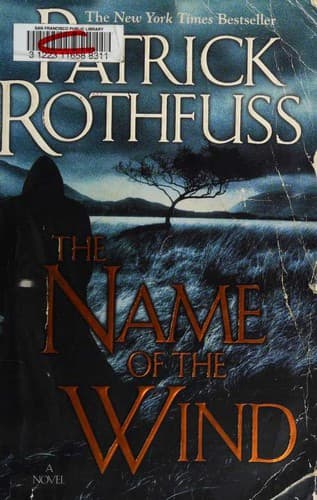
The Name of the Wind
Author: Patrick Rothfuss
Kvothe, considered the most powerful magician of his era, lives hidden under a false identity in a remote village. When a chronicler finds him, Kvothe agrees to tell his story: from his childhood as the son of traveling performers to his becoming a legend.
⚠ Contains spoilersThe post-war world and the innkeeper of Newarre
The story begins at an undefined point in time following an era of great upheaval. The known world bears the scars of recent wars, a deteriorating economy, and a growing presence of dark creatures called skraelings — demonic beings whose appearance multiplies fear among the rural population. Against this backdrop of decay and tension, the narrative is set in Newarre, a small provincial village where a man who calls himself Kote runs a modest inn.
Kote is a red-haired innkeeper of unremarkable appearance who serves ale, keeps his establishment in order, and lives with a studied discretion that places him at the very edge of social invisibility. He is accompanied by his assistant, Bast, a young man of human appearance who is in fact one of the Fae — beings from another world — and who maintains an absolute, somewhat desperate loyalty toward his master. From the outset it is clear that Bast knows Kote's true identity, and that the dim life his master leads is a source of frustration and pain for the young Fae, who believes his lord is allowing himself to die slowly.
The routine of the inn is broken when a group of travelers arrives in Newarre fleeing a skraeling ambush. Among the dead they bring with them is a body bearing wounds that cannot be attributed to any known beast. This incident reveals that something disturbing is moving through the world, and that irrational violence is spreading beyond what the authorities publicly acknowledge.
The arrival of the Chronicler and the beginning of the frame narrative
The true narrative trigger comes with the appearance of Devan Lochees, known as the Chronicler — a collector of stories and historical testimony who travels the roads of the kingdom with the mission of preserving truthful accounts from notable individuals. The Chronicler recognizes in Kote the legendary Kvothe, the most famous, feared, and mythologized figure of his era: a man to whom rumor attributes having killed kings, having called the wind by name, having studied at the University as little more than a child, having survived the night of Caluptena, and having spoken with the Chandrian — demonic entities of immense power whose very existence many consider a myth.
Kvothe, after briefly resisting, agrees to tell his story over three days — one day for each book. This structure establishes the narrative frame that underpins the entire work: the account of adult Kvothe recalling and narrating his own life in the first person to the Chronicler, while Bast listens. The reader understands from the outset that Kvothe has survived everything he is about to recount, but that the cost has been enormous, and that the current version of the character — dim and hidden — is radically removed from the hero he once was.
Childhood among the Edema Ruh and the founding tragedy
Kvothe begins his account from the very beginning. He was born among the Edema Ruh, an itinerant community of artists, musicians, and actors who travel in caravans and are regarded as socially inferior by the settled population. His father, Arliden, is a talented musician working on a song about the Chandrian — the dark entities that oral tradition describes as responsible for great catastrophes. His mother, whose name is not immediately revealed, is equally gifted in the arts.
During his childhood, Kvothe learns music, performance, and the rudiments of sympathy — a form of magic based on creating links between objects in order to transfer energy between them — under the guidance of Abenthy, an arcanist who temporarily joins the family caravan. Abenthy recognizes in the boy an exceptional intelligence and ability, and teaches him the fundamentals of academic knowledge, awakening in Kvothe the desire to enter the University, the most prestigious institution of learning in the known world.
The tragedy that redirects the entire course of Kvothe's existence occurs when he returns to the family caravan after a period of solitary exploration in the forest and finds it completely destroyed. Every member of his family and community has been murdered. The marks of the attack and certain details of the scene point unmistakably to the Chandrian, whose presence is associated with specific signs such as the sudden corrosion of metal and fire that burns blue. This event defines the central conflict of the novel and of the entire trilogy: Kvothe, then a child of around eleven years old, loses everything he has and is marked by the implicit mission of discovering who the Chandrian are, why they attacked his family, and, eventually, confronting them.