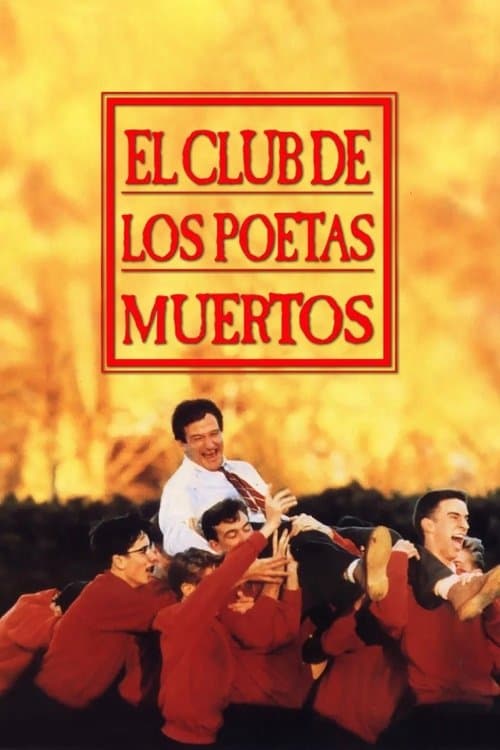
Dead Poets Society
Director: Peter Weir
Cast: Robin Williams, Robert Sean Leonard, Ethan Hawke, Josh Charles, Gale Hansen
At an elite and strict private boarding school in New England, a group of students will discover poetry, the meaning of "Carpe Diem" — seizing the moment — and the importance of pursuing one's dreams, thanks to an eccentric teacher who awakens their minds through unconventional methods.
⚠ Contains spoilersWelton Academy and its universe of tradition
The story takes place in 1959, at Welton Academy, a prestigious and conservative all-male preparatory school located in Vermont. Welton is presented as an elite institution whose educational philosophy rests on four fundamental pillars: Tradition, Honor, Discipline, and Excellence. These principles are not mere decorative words; they permeate every aspect of academic life and shape the relationships between teachers, students, and families. The school grooms young men destined to enter the country's finest universities, and the weight of that expectation bears down on the students constantly and suffocatingly.
The main protagonist is Neil Perry, an intelligent, charismatic, and sensitive student who returns to the boarding school to begin a new academic year. Neil lives under the pressure exerted by his father, Mr. Perry, a rigid and controlling man who has mapped out his son's future in advance: a medical degree at Harvard, with no room for deviation or personal interests. Neil publicly accepts this fate, but inwardly harbors an overwhelming passion for theatre and the performing arts that he finds impossible to ignore.
Among Neil's classmates are several young men who form the central group of the story. Todd Anderson arrives at Welton as a new student, shy and paralyzed by the burden of living in the shadow of his older brother, a distinguished former pupil of the same institution. Knox Overstreet is a hopeless romantic who will soon become obsessed with winning over a girl named Chris, the girlfriend of a football player. Charlie Dalton, also known as Nuwanda, is the most rebellious and impulsive member of the group. Richard Cameron represents the profile of the conventional student — obedient to the rules and above all concerned with his academic record. Steven Meeks and Gerard Pitts round out the circle, figures of lesser prominence but a cohesive part of the collective.
Keating's arrival and the spark of change
The inciting incident that disrupts Welton's established equilibrium is the arrival of a new English Literature teacher: John Keating. A former student of the school itself, Keating returns to the classroom with a methodology radically opposed to the prevailing doctrine. From his very first class, he challenges convention: he invites the students into the hallway to contemplate photographs of previous generations of pupils and reminds them that all those young men are dead, urging them to reflect on the brevity of life with the Latin phrase Carpe Diem, "seize the day." This first gesture profoundly shakes the boys, accustomed as they are to an education based on memorization and blind discipline.
In subsequent classes, Keating instructs his students to tear out the introduction to their official textbook — which proposes a mathematical formula for measuring the quality of poetry — on the grounds that it represents an absurd reduction of the literary experience. He has them stand on their desks to observe the world from a different perspective, and he encourages them to find their own voice. His stated goal is not merely to teach literature, but to awaken in the young men a critical consciousness, the capacity to think for themselves, and the courage to pursue their own passions in the face of external expectations.
Fascinated by this approach, Neil discovers in an old school yearbook that Keating had founded, during his time as a student, a secret society called The Dead Poets Society, whose members would meet at night in a nearby cave to read poetry. Neil convinces his friends to revive the club, and the group begins sneaking out of the boarding school under cover of darkness to hold their own gatherings, where they read Whitman, Thoreau, and other poets, and also share their own writing and innermost thoughts.
The central conflict and its dimensions
The central conflict of the story operates on several simultaneous levels. At the institutional level, Keating's philosophy clashes head-on with the mindset of Welton, represented chiefly by the headmaster Mr. Nolan, a staunch defender of traditional methods. Nolan distrusts the new teacher's approach and watches with suspicion the influence he exerts over the students.
At the personal level, each member of the group faces his own internal tensions. Neil, the most urgent case of all, begins making decisions that place him in direct conflict with his father: when he discovers that a local theatre is staging a production of A Midsummer Night's Dream, he decides to audition in secret and wins the leading role. This choice represents far more than a performance for him: it is the first real assertion of his identity against his father's will.
Todd, for his part, wages a silent battle against his own insecurity and his terror of expressing himself publicly. Knox pursues Chris in defiance of every social convention. Charlie takes Keating's teachings in an increasingly provocative and reckless direction.
The setup is thus established: a group of young men who, under the influence of an unorthodox teacher, begin to awaken to their own desires and to question the destiny others have designed for them, within an institution and an era that will not tolerate dissent.