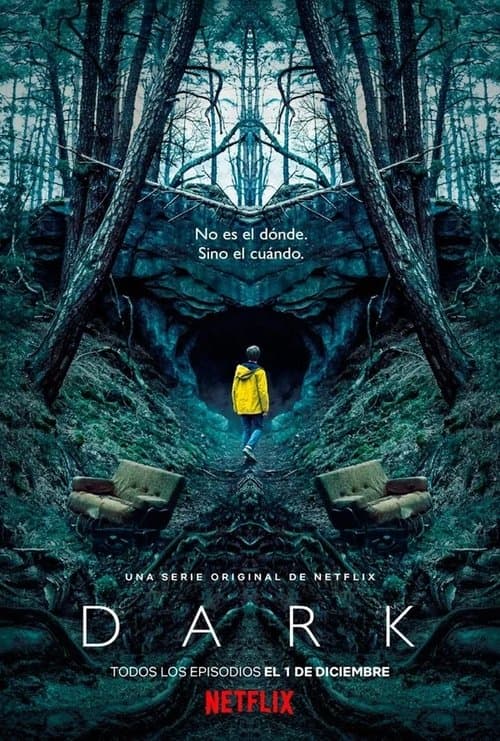
The Town of Winden and Its Intertwined Families
Dark takes place in Winden, a small fictional German town whose history is dominated by the presence of a nuclear power plant and a series of child disappearances that recur cyclically across the decades. The series begins in 2019, though it is soon revealed that present-day events are inextricably linked to those of 1986 and 1953, and later to additional eras. The town functions as a closed ecosystem where four families — the Kahnwalds, the Nielsens, the Dopplers, and the Tiedemanns — have been bound together for generations by ties of blood, secrets, and betrayals that none of them fully understand.
Jonas Kahnwald is the main protagonist of the first season. He is a teenager returning to school after a prolonged absence caused by the suicide of his father, Michael Kahnwald. Jonas carries with him the guilt of having been unable to prevent that death, along with a letter his mother, Hannah Kahnwald, gives him unopened — a letter Michael wrote before taking his own life. That letter, addressed to Jonas, contains a warning about what is about to happen, though Jonas does not read it until later, and when he does, its contents pull him directly into the heart of the temporal mystery.
In his everyday surroundings, Jonas resumes his romantic relationship with Martha Nielsen, his best friend and neighbor, with whom he shares a mutually charged attraction. Martha belongs to the Nielsen family: her father is Ulrich Nielsen, a local police officer obsessed with the town's child disappearances, and her older brother is Bartosz Tiedemann, Jonas's best friend, whose family holds a privileged economic position in Winden.
The Disappearances and the Catalyst for Conflict
The equilibrium of the present is shattered when several children begin to disappear in Winden. The first to vanish is Erik Obendorf, a teenager from Jonas's social circle. Shortly afterward, in the forest near the town — where a cave system with inexplicable properties is located — Mikkel Nielsen, Martha and Ulrich's younger brother, disappears. This second disappearance shakes the families irreversibly and triggers a police investigation, but it also draws Jonas into the caves in search of answers.
The caves turn out to be a temporal portal. Through them, it is possible to travel exactly 33 years into the past or the future. Jonas gradually discovers this, and what he finds on the other side completely alters his understanding of reality: Mikkel has not died or been abducted in the conventional sense. The boy has traveled to the year 1986, where he grows up adopting the name Michael Kahnwald and becoming, decades later, Jonas's own father. This revelation constitutes the series' first major twist and establishes its foundational paradox: Jonas is the son of his own uncle, and Mikkel is simultaneously his father and his uncle, within a time loop that none of those involved have consciously chosen.
The figure operating in the shadows during these initial events is Claudia Tiedemann, though her full role is not revealed immediately. More visible from the outset is Noah, a mysterious priest of calm appearance but sinister motivations, who appears across different eras and is connected to the construction of a time machine and to the disappearances of the children, whose corpses are found with burned eyes and technological artifacts from eras other than their own.
Egon Tiedemann, the family patriarch, investigates child deaths in 1953 that bear an exact parallel to those of the present. Peter Doppler and Elisabeth Doppler represent another of the key families, connected to the cycle through ties that will be revealed over the course of the seasons. At this initial point, all of them are unaware that their lives are trapped within a time loop that was designed — or perhaps simply perpetuated — by forces none of them fully control.
The central conflict of Dark is thus framed around a fundamental question: is it possible to break a cycle when every action intended to alter it is precisely the action that originated it? Jonas sets out believing he can rescue Mikkel and restore order to the world, not yet knowing that he himself is a structural piece of the very disaster he is trying to undo.