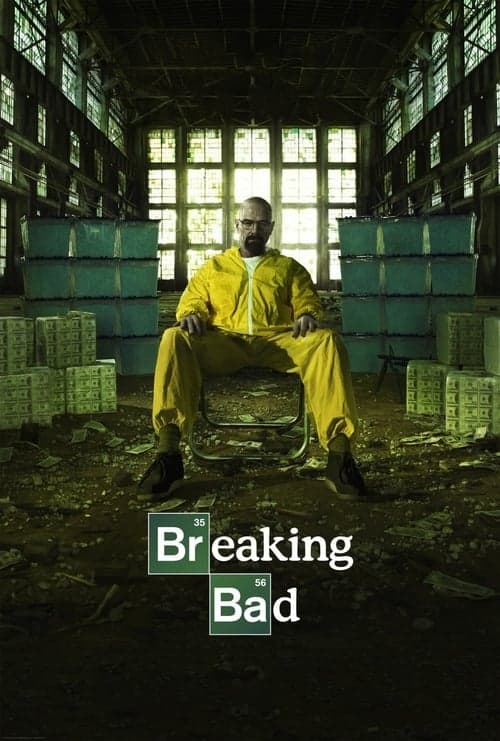
Walter White's world before the break
Breaking Bad is set in Albuquerque, New Mexico, and follows the radical transformation of Walter White, a fifty-year-old man whose life has accumulated quiet frustrations beneath an outward appearance of normalcy. Walter is a chemistry teacher at a high school where his students ignore him and his intellectual talent is systematically wasted. To make ends meet, he works a second shift at a car wash where his own students humiliate him without consequence. He lives with his pregnant wife Skyler White, a practical and caring woman who manages the household finances with discipline, and with his teenage son Walter White Jr., who has cerebral palsy and holds his father in deep admiration.
What Walter does not know—or prefers not to remember—is that in his youth he co-founded the chemical research company Gray Matter Technologies alongside his then-companion and love interest Gretchen. For reasons the series gradually reveals, Walter left the project and sold his share for a negligible sum. That company later became a billion-dollar giant. His former partners Gretchen Schwartz and Elliott Schwartz live in opulence while Walter earns a minimum wage. This buried grievance is the psychological root of everything that follows: Walter is not a man defeated by chance, but someone who believes the world owes him something he never received.
The diagnosis as the trigger
The fragile equilibrium of that life shatters when Walter receives a diagnosis of stage-three, inoperable lung cancer. The doctors give him between one and two years to live. Rather than collapsing emotionally straight away, Walter processes the news with a coldness that already hints at his true character: fear does not paralyze him—it activates him. His central concern is not death itself, but leaving his family without financial resources in a country without universal healthcare. The cancer treatment threatens to ruin them, and Skyler is about to give birth to their second child, a daughter named Holly.
The specific trigger that pushes Walter into the world of drug trafficking occurs when he accompanies his brother-in-law, DEA agent Hank Schrader, on a police raid. Among those detained he recognizes a former student: Jesse Pinkman, a young low-level methamphetamine dealer who manages to escape in the chaos of the operation. Walter deliberately lets him go, then tracks him down with a proposition: they will manufacture methamphetamine together. Walter will contribute the chemical expertise to produce a product of exceptional purity; Jesse will contribute the contacts in the illegal market.
The characters and their motivations at the outset
Jesse Pinkman is, on the surface, Walter's exact opposite. Careless, impulsive, and with little ambition beyond immediate survival, Jesse comes from a middle-class family that has already emotionally written him off. His relationship with drugs is both professional and personal: he uses what he sells. He accepts Walter's proposal with initial mistrust, but financial need and curiosity about the unusual offer ultimately win out.
Hank Schrader, Walter's brother-in-law and husband of Marie Schrader, Skyler's sister, is a loud, boisterous, and apparently self-assured DEA agent. He embodies the law and the conventional masculinity that Walter never represented, and his proximity to the family will become the series' most sustained source of narrative tension: the man hunting the most dangerous drug manufacturer in Albuquerque lives, without knowing it, under the same family roof as his quarry.
The central conflict of Breaking Bad is established clearly from the first episodes: Walter does not cook methamphetamine solely for money. The financial justification is real, but it also functions as a moral alibi. What Walter experiences in the criminal world is something he never found in his legitimate life: recognized competence, control, power, and the feeling of being, for the first time, exactly who he believes he deserves to be. From the outset the series poses the question that will shape its entire arc: whether the cancer is the trigger or simply the excuse Walter needed to become what he always wanted to be. Walter himself will articulate this years later in a line the series reserves for its final stretch, yet whose truth pulses from the very first episode: everything he does, he does for himself.