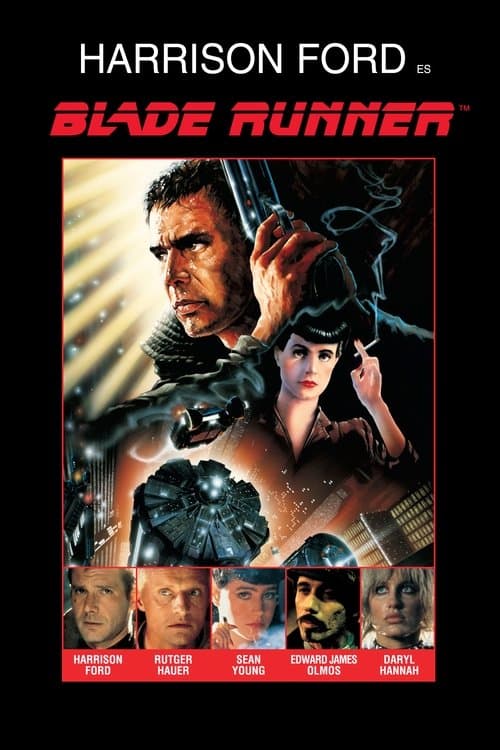
A World in Decay
Los Angeles, November 2019. The city is a labyrinth of neon-lit skyscrapers, perpetual rain, and industrial smog. Overpopulation and pollution have turned the planet into an inhospitable place, to the point that most of those who can afford it have emigrated to off-world colonies located beyond Earth. Those who remain are the ones who have no other option: the poor, the sick, the misfits. On the streets, cultures intermingle in a multicultural chaos where English has absorbed words from dozens of languages. Giant screens advertise the benefits of a new life in outer space, while below, on the ground, decay spreads without remedy.
In this context exists the Tyrell Corporation, a technological giant responsible for the creation of replicants: artificial beings biologically identical to humans, manufactured to work in extreme conditions in the colonies. The latest-generation replicants, the Nexus-6 model, are physically superior to humans and possess intelligence equivalent to or greater than that of their creators. For this reason, their presence on Earth is strictly prohibited. To control any possible incursion, a special police force exists: the Blade Runners, agents trained to detect and retire — the official euphemism for killing — replicants who illegally cross the terrestrial boundary.
Rick Deckard and the Case He Cannot Refuse
Rick Deckard is a retired Blade Runner. When the film begins, he has been away from active service for some time, worn down by a job that consists essentially of executing beings who, from the outside, are indistinguishable from humans. He is a solitary, cynical, and emotionally exhausted man, subsisting in a cluttered apartment in the lower levels of the city, far from the artificial glare of the upper floors.
His former supervisor, Captain Bryant, tracks him down and compels him to return to duty under implicit threat. The trigger for the conflict is the escape of a group of six Nexus-6 replicants who have fled an outer colony, killed several humans in the process, and managed to infiltrate Earth. Four of them have been located in Los Angeles. Bryant assigns Deckard the task of identifying and eliminating them. Deckard has no real ability to refuse.
The four fugitive replicants are Roy Batty, his companion Pris, and two others, Zhora and Leon. Roy Batty is the group's leader: charismatic, extremely intelligent, and physically formidable. His motivation is not chaos or destruction for pleasure, but something far more concrete and tragic: Nexus-6 replicants have a programmed lifespan of four years, a safety limit imposed by Tyrell to prevent them from developing overly complex emotional responses. Roy and his companions are approaching that limit. They have come to Earth in search of their creator, Dr. Eldon Tyrell, in the hope that he can extend their lives. They are not monsters fleeing on instinct: they are conscious beings who do not want to die.
The Voight-Kampff Test and the Question of Humanity
To acquaint the viewer with the mechanics of this world, the film introduces early on the Voight-Kampff test, an empathy examination designed specifically to distinguish replicants from humans. Replicants, though physically perfect, lack a lived emotional history, which produces slightly different physiological responses to stimuli designed to evoke empathic reactions. The test measures pupil dilation, heart rate, and other involuntary responses.
Deckard visits the Tyrell Corporation's facilities to familiarize himself with the specifications of the Nexus-6 model and administers the test to a young woman named Rachael, whom he initially believes to be simply Dr. Tyrell's assistant. However, the test reveals that Rachael is in fact a replicant, though of a special type: Tyrell has implanted her with artificial memories taken from his own niece, which causes Rachael to be unaware that she is a replicant. She genuinely believes her memories are real. Tyrell created her as an experiment to determine whether memory implants allow for greater emotional control in replicants.
This encounter plants the seed of the film's most intimate conflict: if a being has memories, feelings, and the subjective conviction of being human, what truly differentiates it from a person? The question applies to Rachael, but also, in a way that will be progressively revealed, to Deckard himself. The police investigation he must carry out has, from the very beginning, a philosophical dimension that goes far beyond simple pursuit and capture.