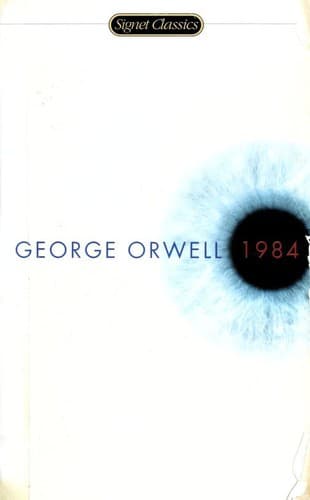
1984
Nineteen Eighty-Four
Author: George Orwell
In a totalitarian future, Winston Smith lives under the omnipresent surveillance of Big Brother and the Party. As a worker at the Ministry of Truth, he rewrites history according to the regime's directives. But Winston harbors a secret: he hates the Party and dreams of rebellion.
⚠ Contains spoilersThe World of Oceania and the Life of Winston Smith
The novel is set in a dystopian future in the year 1984, in a totalitarian state called Oceania, one of three superpowers that divide the world alongside Eurasia and Eastasia. Oceania is governed by a single-party system known as the Party, whose symbolic and omnipresent leader is Big Brother, a figure whose actual existence is never fully confirmed, but whose face—with a black moustache and piercing eyes—appears on posters everywhere bearing the slogan "Big Brother is watching you." The Party exerts absolute control over every aspect of life: the economy, history, language, thought, and the emotions of its citizens. To this end, it operates through four main ministries: the Ministry of Truth (which falsifies history), the Ministry of Love (which handles repression and torture), the Ministry of Plenty (which administers economic scarcity), and the Ministry of Peace (which manages permanent war).
The protagonist is Winston Smith, a 39-year-old man, thin and in fragile health, who works at the Ministry of Truth—ironically referred to as Minitrue in Newspeak—where his job consists of rewriting newspaper articles and historical documents so that they conform to the Party's current official version of events. Winston lives in a dilapidated apartment block in London, capital of Airstrip One, and his daily life is defined by the constant surveillance of telescreens, devices installed in every room that simultaneously transmit and receive both image and sound, so that no one can ever be certain they are not being observed. In addition, children are indoctrinated from an early age as Party spies through the youth organisation known as the Spies, and reporting on one's own parents is considered a heroic act.
The Inciting Incident: Thoughtcrime and the Diary
Despite living under this iron control, Winston harbours a deep and secret distrust of the Party. This internal conflict forms the true starting point of the narrative. The inciting incident that disrupts the equilibrium of his routine—and that constitutes a capital act of rebellion—is Winston's decision to begin writing a personal diary, something that, while not explicitly outlawed, constitutes what the Party calls a "crimethink" or thoughtcrime, punishable by death or disappearance into the labour camps.
In the diary's opening pages, Winston writes in a compulsive and chaotic manner, as though the words were escaping from a reservoir of rage and doubt suppressed over many years. The act of writing represents the assertion of a personal subjectivity and memory within a system that systematically erases both. Winston is aware that, in doing so, he is already condemned; as he himself reflects, the crime is not the act itself but the thought that precedes it, and that thought has existed within him for a long time.
The Main Characters and the Central Conflict
In his work environment, Winston observes two people who will come to hold central importance. The first is Julia, a dark-haired young woman who works in the fiction department of the Ministry of Truth and who ostentatiously wears the scarlet sash of the Anti-Sex League, which initially leads Winston to distrust her and suspect she may be an agent of the Thought Police. The second significant character is O'Brien, a member of the Inner Party—the ruling elite—who radiates an intelligence and sophistication that Winston mistakenly interprets as signs of possible secret dissidence. At one point, Winston believes he catches in O'Brien's eyes a tacit message of complicity, fuelling his fantasy that there exists a clandestine organisation called the Brotherhood, supposedly led by Emmanuel Goldstein, the Party's public enemy number one, a renegade Trotskyist whose image serves as the target of the Two Minutes Hate, daily rituals of directed collective hysteria.
The novel's central conflict is thus laid out in its full dimension from the outset: an isolated individual, physically and psychologically fragile, who has begun to exercise the only truly subversive act possible in Oceania—thinking for himself and remembering—confronts a system designed specifically to make that subversion impossible. The Party does not merely control its citizens' actions; its ultimate objective, which is gradually revealed as the novel progresses, is the absolute control of every human being's inner reality.